Featured post

Nanotechnology: Applications in Agriculture

https://www.youtube.com/watch?v=rNMCbdmHvaE

Thursday, 27 October 2022

Genetic Engineering Appraisal Committee Approves Genetically Modified Mustard for Environmental Release

 Genetic Engineering Appraisal Committee Approves Genetically Modified Mustard for Environmental Release


India’s apex Biotech regulator, Genetic Engineering Appraisal Committee (GEAC), has recommended indigenously developed India’s first-ever transgenic food crop genetically modified mustard containing two alien genes isolated from non-pathogenic soil bacterium called Bacillus amyloliquefaciens. The transgenic mustard variety DMH – 11 was developed by Dr. Deepak Pental, and his colleagues from the Centre for Genetic Manipulation of Crop Plants at the University of Delhi, South Campus.

GM mustard DMH – 11 was created through transgenic technology involving the Bar, Barnase, and Barstar gene systems. The Barnase gene confers male sterility, while the Barstar gene restores DMH – 11’s ability to produce fertile seeds. The insertion of the third gene Bar enables DMH – 11 to produce phosphinothricin-N- acetyl-transferase, the enzyme responsible for Glufosinate resistance. Glufosinate resistance is due to an enzyme expressed by the Bar (Bialaphos resistance) gene. The cloned Bar gene (derived from Streptomyces hygroscopicus) encodes for the synthesis of phosphinothricin-N- acetyl-transferase (PAT). PAT enzymes produced by the Bar gene, deactivate Bialaphos (the tripeptide precursor to phosphinothricin) through acetylation to form an inactive, non-toxic product. This enzyme is responsible for detoxifying the active ingredient in the herbicide Glufosinate-phosphinothricin. Phosphinothricin’s mechanism of action involves the inhibition of Glutamine synthetase, which prevents the detoxification of ammonia and subsequently causes toxic buildup within plant cells. Inhibition of glutamine synthetase also leads to an overall reduction in Glutamine levels. In plants, Glutamine acts as a signaling molecule, and as a major amino acid donor for nucleotide synthesis. Hence, this GM mustard DMH – 11 is Glufosinate tolerant, and therefore it is thought to encourage farmers to liberally spray the herbicide upon commercialization.

So far, India has not approved any commercial cultivation of transgenic food crops. It will be the first GM food to be approved by Govt of India for commercial cultivation. This approval for GM mustard was a long wait but better late than never. Transgenic Bt-cotton was allowed for cultivation by the Government of India in the year 2002. The decision comes on the backdrop of soaring edible oil prices in the past few years. India meets 70 percent of its domestic cooking oil demand by importing a variety of oils such as sunflower, soybean, and palm. Still, we are continuing to import larger volumes of GM soybean oil from USA, Brazil, and Argentina. India has imported 4.1 million tonnes of GM soybean oil in 2021-22. The decision by GEAC was taken during its 147th meeting held on October 18, 2022. The regulator recommended the “environmental release of mustard hybrid DMH-11 for its seed production and testing as per existing ICAR guidelines and other rules/regulations before proper commercial release. GM mustard was found not to pose any food allergy risks and has demonstrated increased yields over existing mustard varieties. Conflicting details and results regarding the field trials and safety evaluations conducted on GM mustard have delayed its approval for commercial cropping.

In 2017, GEAC has recommended the commercial release of GM mustard but due to objections from Swadeshi Jagran Manch, an affiliate of RSS, the Govt. of India has put it on hold. Similarly, transgenic brinjal was put on indefinite moratorium in 2010 by then environment minister Jairam Ramesh. GM mustard technology will now accelerate mustard breeding programs for bringing a new revolution in mustard farming by enhancing edible oil production in the country. The project to develop DMH – 11 received funding from the National Dairy Development Board of India and the Department of Biotechnology (DBT).


Friday, 25 March 2022

The potential of Smart Agriculture Technology through Public Partnership Programmes (PPPs)

The potential of Agriculture Technology via Public Partnership Programmes (PPPs)
The centre and state governments are interested to deliver hi-tech services to farmers through PPPs. This model can play an important role for creating a viable ecosystem for smart futuristic agriculture technology.
For more information, please browse the link:

https://www-thehindubusinessline-com.cdn.ampproject.org/c/s/www.thehindubusinessline.com/opinion/unlocking-the-potential-agri-tech/article65255349.ece/amp/

For example:

Use of Drone to spray pesticides and fertilizers
(Photo Credit:Siva Saravanans)

Thursday, 6 May 2021

Smart Intelligent Agriculture: Applications of Recent Nanosensors Technology

  Smart Intelligent Agriculture: Applications of Recent Nanosensors Technology


Agriculture requires technical solutions for increasing production while lessening environmental impact by reducing the application of agrochemicals and increasing the use of environmentally friendly management practices. Both biotic and abiotic stresses lead to a massive loss in crop yield, leading to a decrease in agricultural production worldwide. The loss of agricultural products can be minimized by adopting modern technology such as smartphones with nanosensors to detect crop stress at an early stage. Smart and precision agriculture are emerging areas where nanosensors and electronic devices can play an important role for improving crop productivity by monitoring crop health status in real-time. Various types of nanosensors have been reported for detection and monitoring plant signal molecules and metabolic contents related with biotic and abiotic stresses. Nanobiosensors are customized using various properties of nanomaterials to combat various challenges of contemporary techniques.  Nanobiosensors have unprecedented levels of performance for sensing ultra-trace amount of various analytes for in vivo measurement. These nanosensors communicate with and actuate electronic devices for agricultural automation. Thus, both biotic and abiotic plant stresses and nutritional deficiency are monitored in real-time to report crop health status for precise and efficient use of resources. 


For more information, please click the following presentation:

Smart Agriculture


Friday, 29 December 2017

Deciphering the mode of interactions of nanoparticles with mung bean (Vigna radiata L.)

Interactions of Nanoparticles with Mung Bean (Vigna radiata L.)


Deciphering the mode of interactions of nanoparticles with mung bean (Vigna radiata L.): (2017). Deciphering the mode of interactions of nanoparticles with mung bean (Vigna radiata L.). Israel Journal of Plant Sciences. Ahead of Print.

Monday, 18 December 2017

Nanotechnology: Characterization of Nanomaterials using Single-Particle Inductively Coupled Plama Mass Spectrometry

The term ‘nanotechnology’ was introduced in 1974 by Japanese scientist Norio Taniguchi but the  original concept behind this massively developed field of science was introduced by Richard Feymman in his 1959 speech titled “There’s Plenty of Room at the Bottom.”  Since its initial introduction into the world, the application of nanotechnology has found an ability to revolutionize and improve almost every technology of world today.  The National Nanotechnology Initiative defines nanomaterials as those with dimensions of 1-100 nm. Due to their unique properties, nanomaterials have found their way into many everyday consumer products. Products based on nanotechnology are already manufactured in the field of electronics, pharmaceutical industry, food associated industries, agriculture, consumer products The widespread application of nanomaterials has inevitably led to their release into the environment, which raises concern about their potential adverse effects on the ecosystems and their impact on health.  The measurement and characterization of nanoparticles is therefore critical to all aspects of nanotechnology. Complete characterization of nanomaterials is important for interpreting the results of toxicological and human health studies. Metal-containing nanoparticles are particularly significant class because their use in consumer and industrial applications makes them the fastest growing category of NPs. Hence, innovative analytical approaches are essential for monitoring the presence of nanomaterials in environmental and biological media, assessing their potential impact and supporting regulations.

Many analytical techniques are available for nanometrology, only some of which can be successfully applied to environmental health studies. Methods for detecting, quantifying and characterizing these materials in complex matrices are critical for the eventual understanding of their implications to environmental quality and human health. Methods for assessing particle size distribution include electron microscopy, chromatography, laser-light scattering, ultrafiltration and field-flow fractionation. Common approaches used to characterize nanomaterials include optical properties methods e.g. dynamic light scattering (DLS) and microscopy based methods e.g. transmission electron microscopy (TEM). One more technique that is proving invaluable for detecting and sizing metallic nanoparticles is single-particle-Inductively coupled mass-spectrometry (SP-ICP-MS) as shown in figure 1.

 Figure 1.  The process of nanoparticle sizing using SP-ICP-MS


Its combination of elemental specificity, sizing resolution and unmated sensitivity makes it extremely applicable for the characterization of nanoparticles which have been integrated into larger products such as foods, consumer goods, personal care products, and pharmaceuticals. Generally, SP-ICP-MS is used to characterize populations of nanoparticles suspended in aqueous solutions. SP-ICP-MS takes advantage of the well-established elemental techniques of ICP-MS but performing measurements on ‘particle by particle’ basis as shown in figure 2. Single particle analysis using ICP optical emission spectrometry was first reported in 1986. This technique was initially adopted for analysis of aerosol and airborne particles.  Subsequently, this methodology was implemented for study of colloidal and microparticle suspensions.


Figure 2.  Measurement of nanoparticle under the single particle mode of SP-ICP-MS


SP-ICP-MS is an emergent ICP-MS method for detecting, characterizing and quantifying nanomaterials.  This can be considered one of the innovative and emerging analytical approaches to provide information about the elemental chemical composition of noncarbon nanomaterials as well as their number concentration, size and number size distribution. Its combination of elemental specificity, sizing resolution, and unmatched sensitivity makes it extremely applicable for the characterization of nanoparticles containing elements such as titanium, gold, silver, silicon, which have been integrated into larger products such as foods, consumer goods, personal care products and pharmaceuticals.

The basic assumption behind SP-ICP-MS is that each recorded pulse represents a single nanoparticle.  A very dilute suspension is introduced into the ICP-MS instrument, such that statistically only one nanoparticle at a time enters the plasma. The plasma atomizes and ionizes the constituents of the nanoparticle, which are then quantified using the mass spectrometer. The parameters of the nanoparticle population than can be measured include the mean size, size distribution, NP number concentration and NP mass concentration. The frequency of the pulses is directly related to the number concentration of NPs and the intensity of each pulse is proportional to the mass of elements, in fact to the number of atoms, in each detected nanoparticle.  SP-ICP-MS involves introducing nanoparticle-containing samples of environmentally significant concentrations into the ICP-MS system and collecting time-resolved data.  Due to the very low elemental concentrations and the transient nature of ionized nanoparticle, very short measurement times and high sensitivity are essential to ensure the detection of individual particles as ion pulses. The number of observed pulses at the detector is related to the nanoparticle concentration by the nebulization efficiency and the total number of nanoparticles in the sample, while the size of the nanoparticle is related to the pulse intensity.

A strength of SP-ICP-MS is that no instrument modifications is required i.e. it can be performed using off-the-shelf ICP-MS. But, as the development in SP-ICP-MS techniques is taking place, additional or uncommon instrument capabilities such as very short detector dwell times in the range of microseconds, automated data reduction software and hyphenation with front-end separation techniques (field-flow fractionation) are being viewed as necessary improvements by the instrument manufactures. Second important strength is its excellent detection capability in terms of nanoparticle number or mass concentration. However, there are some demerits of SP-ICP-MS also. For example, the technique can measure only one or at most two, isotopes in a single analysis using quadrapole instruments, the most common type of ICP-MS instrument. The detection power in terms of nanoparticle size is still somewhat lacking, with typical limits of detection ranging from 10 nm to 20 nm (spherical diameter) for monoisotopic NPs. Samples must be prepared or altered in such way to be compatible with ICP-MS sample introduction system.  While considerable progress and much advancement have been made, the SP-ICP-MS is still best considered an emerging technique in understanding the environmental, health and safety implications of nanoparticles.

References

1.      Deguldre C, Favarger PY. Colloid analysis by single particle inductively coupled plasma mass       spectrometry: a feasibility study. Colloid Surf A. 2003; 217:137-42.
2.      Laborda F, Bolea E, Jimenz-Lamana J. Single particle inductively coupled plasma mass spectrometry: a powerful tool for nanoanalysis. 2014; 86:2270-78.
3.      Bustos ARM, Winchester MR. Single-particle –ICP-MS advances. 2016; 408:5051-52.
4.      Stephan C, Thomas R. Single-particle ICP-MS: A key analytical techniques for characterization nanoparticles. Spectroscopy, 2017; 32:12-25.
5.      http://alfresco.ubm-us.net/alfresco_images/pharma
6.      https://www.agilent.com/en/newsletters/accessagilent/2013/sep/nanoparticles

Thursday, 21 July 2016

Intelligent Nano-Fertilizers


Intelligent Nano-Fertilizers


The plant needs different amount of nitrogen depending on its growth stage. Nitrogen-use efficiency for most crops ranges from 30 to 50 percent. A new generation of fertilizers will increase this efficiency from 30 percent to upwards of 80 percent. Smart biosensors and smart delivery systems will help in enhancing productivity in agriculture. Intelligent nano-fertilizers can reduce the amount of nitrogen lost during the crop production. 


http://www.biotecharticles.com/Nanotechnology-Article/Intelligent-Nano-Fertilizers-3544.html


Intelligent Nano-Fertilizers


Intelligent Nano-Fertilizers


The plant needs different amount of nitrogen depending on its growth stage. Nitrogen-use efficiency for most crops ranges from 30 to 50 percent. A new generation of fertilizers will increase this efficiency from 30 percent to upwards of 80 percent. Smart biosensors and smart delivery systems will help in enhancing productivity in agriculture. Intelligent nano-fertilizers can reduce the amount of nitrogen lost during the crop production. 


http://www.biotecharticles.com/Nanotechnology-Article/Intelligent-Nano-Fertilizers-3544.html


Monday, 6 June 2016

Agricultural Biotechnology


Biotechnology refers generally to the application of a wide range of scientific techniques to the modification and improvements of plants, animals, and microorganisms that are of economic importance. Agricultural biotechnology is that area of biotechnology involving application to agriculture. In the broadest sense, traditional biotechnology has been used for thousand of years, since the advent of the first agricultural practices, for the improvement of plants, animals and microorganisms. The application of biotechnology to agriculturally important crop species has traditionally involved the use of selective breeding to bring about an exchange of genetic material between two parent plants to produce offspring having desired traits such as increase yield, disease resistance and enhanced product quality. The exchange of genetic material through conventional breeding requires that the two plants being crossed are of the same, or closely related species and so it can take considerable time to achieve desired results. Modern biotechnology vastly increase the precision and reduces the time with which these changes in plant characteristics can be made and greatly increase the potential sources from which desirable traits can be obtained.


Tuesday, 31 May 2016

Nanotechnology: Applications in Agriculture

Nanotechnology : Applications in Agriculture (PowerPoint Presentation)


Wednesday, 25 May 2016

NanotechnologyAgriculture

Friday, 20 May 2016

Smart Nanofertilizers for Agriculture

Smart Nanofertilizers


Mineral nutrients  such as nitrogen, phosphorous potassium, calcium, magnesium, sulphur, and other micronutrients are essential for plant growth and crop production.  Presently, we face a glaring contrast of insufficient use of nutrients on one hand and excessive use on another. Nutrients Use efficiency (NUE) represents a key indicator to assess progress towards better nutrient management. Fertilizers are chemical compounds applied to promote plant growth. It is applied either through the soil or by foliar feeding. Artificial fertilizers are inorganic fertilizers formulated in approximate concentration to supply the nutrients. Nitrogen is an important source which is essential for the growth of plant. Urea is the most wildly used water soluble plant nitrogen source. Due to leaching the nitrogen content in the soil get decreased leading to low nitrogen utilization efficiency.

Nitrogen-use efficiency for most crops ranges from 30 to 50 percent, so researchers are developing intelligent nano-fertilizers to reduce the amount of nitrogen lost during the crop production.  The plant needs different amount of nitrogen depending on its growth stage. A new generation of fertilizers will increase this efficiency from 30 percent to upwards of 80 percent. The idea is to develop a product that will release nitrogen only when the plant needs it and in the amount the plant needs. The plants communicate their surroundings environment by producing all kinds of chemical signals. A plant synthesizes specific compounds to communicate with specific microbes. The microbes then go to work and free nitrogen that the plant uses to grow. Thus, roots send out signal that ask microbes to transform nitrogen in the soil into a chemical form the plant can use. Many chemical compounds that are associated  with nitrogen uptake have been identified. These compounds can be used to synchronize the release of fertilizer with nitrogen uptake by the crop. 

A biosensor is a device that combines a biological recognition element with a physical or chemical transducer to detect a biological product. In other words, it is a probe that integrates a biological one with an electronic component to yield a measurable signal. Several biosensors are being developed for different applications. Typically a biosensor consists of three components: the biological recognition element, the transducer and the signal processing electronics. Nano-biosensors that will bind to these compounds can be developed so as to control of the release of fertilizers. The polymers coatings that protects the fertilizers from the elements contains nano-sized biosensors which are made up of very specific chemical compounds that allow the fertilizers to be released into the soil when the plant needs it. These biosensors know when to release nitrogen because they are able to detect chemical signals released from the roots of the plant to the soil. Biosensors can detect when a plant requires more nitrogen and allow microbes access to the fertilizer-nitrogen inside the polymer protected particles. 

Each plant species sends out its own variety of chemical signals. Keeping this concept in mind, a smart nano-fertilizer product could be tailored to respond differently to the needs of different crops. For instance, the nitrogen particles could be designated to become available to wheat, but not to the canola growing in the same field because of different compounds emitted by different crops. We can prepare different biosensors using different compounds and tailor the fertilizers to each different crop for different climatic zones and soils. Dr. Carlos Montreal of Agriculture and Agri-Food Canada in Ottawa is one of the several research scientists developing a fertilizer that responds to organic compounds emitted by a plant’s roots. The research team is trying to make  intelligent fertilizers with the biodegradable three-dimensional polymer coating less than 100 nm  thick. Hence, in coming years farmers could have access to an intelligent nano-fertilizers  that synchronizes the release of nitrogen with crop uptake.


Thursday, 19 May 2016

Smart and Intelligent Nano-Fertilizers

Nanotechnology for developing smart and intelligent Nano-Fertilizers. 


Saturday, 7 May 2016

Nanotechnology in Agriculture : Future Prospective

Nanotechnology  in Agriculture


The use of nanomaterials for delivery of pesticides and fertilizers is explored to reduce the dosage and ensure controlled slow delivery but the risk assessment of the use of nanomaterials is still not defined. Toxicity of the ecosystem, potential residue carry-over in foodstuff and nanomaterials phytotoxicity are some of the major concern for application of nanomaterials in agriculture. The health concern of nanomaterials has been reviewed . There is need to evaluate the toxicokinetics and toxicodynamics of nanomaterials used in agricultural production. Nanomaterials owing to increased surface area might have toxic effects that are not apparent in the bulk materials especially in open agricultural ecosystem. The selection of nanomaterials for application in the field may be critical as materials which are non-toxic, biodegradable and biocompatible are desirable. Nanofabrication with hyper-accumulator plant or in combination with soil microorganism will provide the approach of “Designer plant” boosting up the nutrient uptake and phytomining efficiency.  This can be achieved in future by nano-biofarming or particle farming. This is one such field which yields nanoparticles for industrial use by growing plants in defined soil.

Smart precision farming will make use of computers, global satellite positioning system and remote sensing devices to measure highly localized environmental conditions enabling us to know whether crops are growing at maximum efficiency. Nanotechnology may be developed and deployed for real-time monitoring of the crop growth and field conditions including moisture level, soil fertility, temperature, crop nutrient status, insects, plant diseases, weeds. Networks of wireless nanosensors positioned across cultivated fields will provide essential data leading to best agronomic intelligence processes with the aim to minimize resource inputs and maximize output.

Humidity, light temperature, soil conditions, fertilization, insects, and plant diseases all affect the release of volatile organic compounds which could be detected by electronic nose. Electronic noses in agriculture will detect crop diseases, identify insect infestation, and monitor food quality. The electronic nose could also be used in food industry to assess the freshness spoilage of fruits and vegetables during the processing and packaging process. Smart dust technology will be used for monitoring various parameters such as temperature, humidity, insect and disease infestation in future. This is the future of agriculture, an army of nanosensors will be scattered like dust across the farms and fields, working like the eyes, ears and nosed of the farming world. These tiny wireless sensors are capable to communicate the information they sense. These will be programmed and designed to respond various parameters like variation in temperature, nutrients and humidity.


In summary, the development of nanomaterials with good dispersion and wettability, biodegradable in soil, and environment, less toxic and more photo-generative, with well understood toxicokinetics and toxicodynamics, smart and stable, and ease of fabrication and application in agriculture, would be ideal for their effective use in agricultural crop production. 

Friday, 6 May 2016

Nano-Foods

Nanofood is defined as the food derived from the use of nanotechnology techniques or tools during cultivation, production, processing or packaging. After harvesting, crop is processed and then it reaches to consumers in the form of food. One common problem encountered in food sector is that it loses its freshness and quality before reaching to the consumers. Generally food contains bacteria and viruses which ends in illness and sometimes fatality. Nanotechnology can play an important role by designing smart biosensors that can be packed along with the food material. These smart biosensors will warn the consumers about the freshness of the food by colour change indicators. So if there is large concentration of bacteria in a particular food, the biosensor will produce a strong signal indicating the food as unsafe to eat. Biosensors developed on the basis of nanotechnology can detect pathogen in the food matrices. Multifunctional FeO NPs with their surface attached to antibodies can specifically bind to the microorganism can be used for their detection in complex food matrices.

A major problem in food science is determining and developing an effective packaging material. Quality and freshness of food can also be maintained by designing smart packaging materials using nanotechnology to keep the food fresh for longer duration. In addition, many companies are also adding NPs to dietary supplements to enhance their bioavailability and efficacy. Nutraceuticals like lycopene, beta-carotene, lutein, phytosterols, have been incorporated into nanosize self-assembled liquid structures to deliver nutrients to cells. Food and cosmetic companies are working together to develop new mechanism to deliver vitamins directly to the skin.

Nanotechnology may provide solutions to nanoscale biosensors for pathogen detection and to delivery systems for bioactive ingredients in foodstuffs through improved knowledge of food material and their uptake at the nanoscale. Consumers need to be aware of the risk that nanofood may suffer the destiny as genetically modified (GM) crops. Products developed by using nanotechnology are flooding the market in food industry. But there are no specific rules and regulations to check their risks.


A number of factors contribute to a demand for the traceability of food throughout production, processing, distribution and consumption. Nanotechnology based tracing devices can integrate multiple functional devices that provide other important information such as sensors for detection of the presence of pathogens, spoilage microorganism, allergen, chemicals, and other contaminants in food as well as nutritional information. Nanoscale tagging devices can be used to record and retrieve information about the product history. These types of applications will help producers, retailers and consumers regarding food safety. 


Thursday, 5 May 2016

Nano-Biosensors

    A biosensor is a device that combines a biological recognition element with a physical or chemical transducer to detect a biological product. In other words, it is a probe that integrates a biological one with an electronic component to yield a measurable signal. Several biosensors are being developed for different applications. Typically a biosensor consists of three components: the biological recognition element, the transducer and the signal processing electronics and functions at five different levels:
  •        Bioreceptor that bind the specific form to the sample
  •       Electrochemical interface where specific biological processes occur giving rise to a         signal
  •       A transducer that converts the specific biochemical reaction in an electrical signal
  •       A signal processor for converting the electronic signal into a meaningful physical            parameter 
  •       A proper interface to display the results to the operator

    Various nanomaterials have been used in biosensors technology to produce nanobiosensors. Various nanomaterials are implemented either into transducers or receptors operation parts, so as to enhance their multidetection capability and sensitivity. These nanomaterials are nanoparticles, nanotubes, quantum dots (QDs) or other biological nanomaterials. These nanomaterials can contribute to either the bio-recognition element or the transducer or both, of a biosensor. Nanoparticles-based biosensor are particularly attractive because they can be easily synthesized in bulk using standard chemical techniques. Biosensors may be classified according to the mechanism of biological selectivity (bioreceptor) otherwise, on the mode of physiochemical signal transduction (transducer). Bioreceptor is a molecular species that exploits a biochemical mechanism of recognition. They are accountable for binding the concerned analyte to the sensor for measurement. Bioreceptor can broadly be classified into five distinct classes. These classes comprise antibody-antigen bioreceptor, enzymatic bioreceptor, nucleic acids (DNA) bioreceptor, cellular bioreceptor, biometric bioreceptor and bactriophage bioreactor. The transducer plays a crucial part in the detection and identification process of a biosensor. The transduction methods such as optical, electrochemical and mass based are the most favored and universal method.

Surface plasmon resonance (SPR) is a robust tool that can measure the binding kinetics of two molecules without the help of any fluorescent tag. Thus, this technique can be said as peculiarity that appears during optical illumination of a metal surface and can be adopted for biomolecular interaction analysis. The advantages affiliated with this are that it takes less time to detect binding events since it is label-free, it excluded additional reagents, assays and steps. Aptamers are those which work with the principle of target specific binding with high affinity, they are single stranded nucleic acid, they fit for the target in all the way forming three dimensional with strict bonding can be produced in vitro.  This kind of nanosensors gives more specific and effective detecting plant diseases, crop resistance and yield production.

Smart dusts are the devices made up of micro sized electro chemical sensors contained in it.  It works on three principles, sensing, processing and computing. This technology gains popularity in a way of its operations. It can be monitored with wireless radios, transducer irrespective of location of sensor, its size is very small due to which it can be undetectable. Major power of sensing itself to the environmental changes, automation and computing has made it come to greater extent. Smart dust technology could be used for monitoring various parameters such as temperature, humidity, insect and disease infestation, but still there are major drawbacks faced by this technology like the impact on environment, toxicity.

             Electronic nose (E-nose) consists of an array of gas sensors  which are composed of NPs e.g. ZnO nanowires with a broad and partly overlapping selectivity and an electronic pattern recognition system with multivariate statistical data processing tools. Their resistance changes with the passage of the certain gas and generate a change in electrical signal that form the fingerprint pattern for gas detection. This pattern is used to determine the type, quality, and quantity of the volatile organic compounds being detected. Plants release volatile organic compounds as a byproduct of everyday physiological processes and these specific compounds and the quantities release are indicative of both the crop and field conditions. 


Thursday, 21 April 2016

Nano-Pesticides and Nano-Herbicides

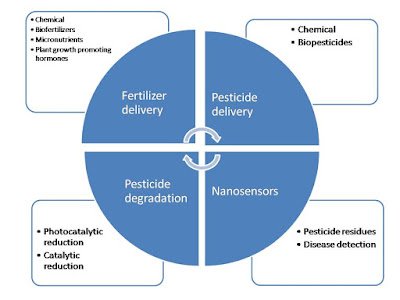
Nanotechnology has potential for efficient delivery of chemical and biological pesticides using  nanosized preparations or nanomaterials based agrochemical formulations. The active ingredient is adsorbed, attached, encapsulated or entrapped unto or into the nano-matrix. Controlled release of the active ingredient is achieved due to the slow release characteristics of the nanomaterials, bonding of the ingredients to the material and the environmental conditions. The benefits of NMs based formulations are the improvement of efficacy due to higher surface area, higher solubility, higher mobility and lower toxicity due to elimination of organic solvents. Nanopesticides involve either very small particles of pesticidal active ingredients or other small engineered structure with useful pesticidal properties. Nanopesticides can increase the dispersion and wettability of agricultural formulations and unwanted pesticide movement. Nanomaterials and biocomposites exhibit useful properties such as stiffness, thermal stability, solubility, permeability, crystallity and biodegradability needed for formulating  nanopesticide.  Nanopesticides also offer large specific surface area and hence increased affinity to the target. Nanoemulsions, nanoencapsulates, nanocontainers and nanocages are some of the nanopesticides delivery techniques that have been discussed recently. Nanopesticides delivery techniques have the ability to control or delayed delivery, absorption and more effective and environmentally friendly approach. Currently spraying of pesticides involves wither knapsacks that deliver large droplets associated with splash loss or ultralight volume sprayer for controlled droplet application with smaller droplets causing spray drift. Constraints due to droplet size may be overcome by using NP encapsulated or nanosized pesticides that will contribute to efficient spraying and reduction of spray drift and splash losses. 

Basically, the nano-formulation should degrade faster in the soil and slowly in plants with residue level below the regulatory criteria in food stuff. The sodium dodecyl sulphate (SDS) is used to increase the photo-degradation of the nanoparticles in soil. The SDS modified Ag/TiO2 imidacloprid nanoformulation has been developed using a microencapsulation technique that used chitosan and alginate. Formulation stability is also an important aspect at the nano level.  A stable nanopesticide (bifenthrin) using polymer stabilizer such as Polyvinylpyrrolidone (PVP), Polyvinyl alcohol (PVOH), and Poly(acrylic acid)-b-poly(butyacrylate (PAA-b-PBA) has been formulated successfully.

Plants provide a non-toxic source of molecules with proven biological efficacy that are usually non-persistent in fresh water and soil. However, phytochemcials such as secondary metabolites and essential oils face problems of stability and cost effectiveness. Incorporation of Artemisia arborescens essential oil into solid lipid NPs (200-204 nm) reduced the rapid evaporation of essential oil. Amorphous nanosilica is obtained from various sources such as the shell wall of phytoplankton, volcanic soil, displayed promising potential as a biopesticide. Nano-silica may be useful against stored grain, household pests, fungal organism, worms etc.

Bacteria, viruses and fungi can function as biological control agents against insect pests. Bacterial and viral formulations need to be ingested by the host and are susceptible to desiccation, heat and UV inactivation. The use of nano-formulations may offer new ways to enhance the stability of these biological agents. Mycopesticides or fungal biocontrol agents are promising as they act by contact and do not need ingestion, can be easily mess produced, and are relatively specific. Microbial products such as enzymes, inhibitor, antibiotics and toxins are promising as biopesticides against plant pests and pathogens. The insecticidal properties of bacterial toxins (Bt) are well known. However, microbial products need stabilization and directed delivery mechanism towards identified targets. Chitosan or clay as stabilizing and delivery agents have potential of biocompatible and biodegradable nanomaterials.

Unwanted plants along with the desired plant crops are called weeds. To kill these weeds, herbicides are used but conventional herbicide when sprayed has a chance of getting affected to the foods crops too by this and there can be huge loss in the crop yield. By using nano herbicide which is 1-100 nm range will try to mingle with the soil particle and try to destroy the entire weeds from their roots by not affecting other food crops. As the nanoparticles are target specific they can be used to kill the weeds and destroy it to get better yield. Herbicides like atrazine, triazine could be encapsulated to get efficient release to the plants.