Featured post

Nanotechnology: Applications in Agriculture

https://www.youtube.com/watch?v=rNMCbdmHvaE

Showing posts with label Smart Precision Farming. Show all posts

Thursday, 6 May 2021

Smart Intelligent Agriculture: Applications of Recent Nanosensors Technology

  Smart Intelligent Agriculture: Applications of Recent Nanosensors Technology


Agriculture requires technical solutions for increasing production while lessening environmental impact by reducing the application of agrochemicals and increasing the use of environmentally friendly management practices. Both biotic and abiotic stresses lead to a massive loss in crop yield, leading to a decrease in agricultural production worldwide. The loss of agricultural products can be minimized by adopting modern technology such as smartphones with nanosensors to detect crop stress at an early stage. Smart and precision agriculture are emerging areas where nanosensors and electronic devices can play an important role for improving crop productivity by monitoring crop health status in real-time. Various types of nanosensors have been reported for detection and monitoring plant signal molecules and metabolic contents related with biotic and abiotic stresses. Nanobiosensors are customized using various properties of nanomaterials to combat various challenges of contemporary techniques.  Nanobiosensors have unprecedented levels of performance for sensing ultra-trace amount of various analytes for in vivo measurement. These nanosensors communicate with and actuate electronic devices for agricultural automation. Thus, both biotic and abiotic plant stresses and nutritional deficiency are monitored in real-time to report crop health status for precise and efficient use of resources. 


For more information, please click the following presentation:

Smart Agriculture


Thursday, 21 July 2016

Intelligent Nano-Fertilizers


Intelligent Nano-Fertilizers


The plant needs different amount of nitrogen depending on its growth stage. Nitrogen-use efficiency for most crops ranges from 30 to 50 percent. A new generation of fertilizers will increase this efficiency from 30 percent to upwards of 80 percent. Smart biosensors and smart delivery systems will help in enhancing productivity in agriculture. Intelligent nano-fertilizers can reduce the amount of nitrogen lost during the crop production. 


http://www.biotecharticles.com/Nanotechnology-Article/Intelligent-Nano-Fertilizers-3544.html


Intelligent Nano-Fertilizers


Intelligent Nano-Fertilizers


The plant needs different amount of nitrogen depending on its growth stage. Nitrogen-use efficiency for most crops ranges from 30 to 50 percent. A new generation of fertilizers will increase this efficiency from 30 percent to upwards of 80 percent. Smart biosensors and smart delivery systems will help in enhancing productivity in agriculture. Intelligent nano-fertilizers can reduce the amount of nitrogen lost during the crop production. 


http://www.biotecharticles.com/Nanotechnology-Article/Intelligent-Nano-Fertilizers-3544.html


Tuesday, 31 May 2016

Nanotechnology: Applications in Agriculture

Nanotechnology : Applications in Agriculture (PowerPoint Presentation)


Friday, 20 May 2016

Smart Nanofertilizers for Agriculture

Smart Nanofertilizers


Mineral nutrients  such as nitrogen, phosphorous potassium, calcium, magnesium, sulphur, and other micronutrients are essential for plant growth and crop production.  Presently, we face a glaring contrast of insufficient use of nutrients on one hand and excessive use on another. Nutrients Use efficiency (NUE) represents a key indicator to assess progress towards better nutrient management. Fertilizers are chemical compounds applied to promote plant growth. It is applied either through the soil or by foliar feeding. Artificial fertilizers are inorganic fertilizers formulated in approximate concentration to supply the nutrients. Nitrogen is an important source which is essential for the growth of plant. Urea is the most wildly used water soluble plant nitrogen source. Due to leaching the nitrogen content in the soil get decreased leading to low nitrogen utilization efficiency.

Nitrogen-use efficiency for most crops ranges from 30 to 50 percent, so researchers are developing intelligent nano-fertilizers to reduce the amount of nitrogen lost during the crop production.  The plant needs different amount of nitrogen depending on its growth stage. A new generation of fertilizers will increase this efficiency from 30 percent to upwards of 80 percent. The idea is to develop a product that will release nitrogen only when the plant needs it and in the amount the plant needs. The plants communicate their surroundings environment by producing all kinds of chemical signals. A plant synthesizes specific compounds to communicate with specific microbes. The microbes then go to work and free nitrogen that the plant uses to grow. Thus, roots send out signal that ask microbes to transform nitrogen in the soil into a chemical form the plant can use. Many chemical compounds that are associated  with nitrogen uptake have been identified. These compounds can be used to synchronize the release of fertilizer with nitrogen uptake by the crop. 

A biosensor is a device that combines a biological recognition element with a physical or chemical transducer to detect a biological product. In other words, it is a probe that integrates a biological one with an electronic component to yield a measurable signal. Several biosensors are being developed for different applications. Typically a biosensor consists of three components: the biological recognition element, the transducer and the signal processing electronics. Nano-biosensors that will bind to these compounds can be developed so as to control of the release of fertilizers. The polymers coatings that protects the fertilizers from the elements contains nano-sized biosensors which are made up of very specific chemical compounds that allow the fertilizers to be released into the soil when the plant needs it. These biosensors know when to release nitrogen because they are able to detect chemical signals released from the roots of the plant to the soil. Biosensors can detect when a plant requires more nitrogen and allow microbes access to the fertilizer-nitrogen inside the polymer protected particles. 

Each plant species sends out its own variety of chemical signals. Keeping this concept in mind, a smart nano-fertilizer product could be tailored to respond differently to the needs of different crops. For instance, the nitrogen particles could be designated to become available to wheat, but not to the canola growing in the same field because of different compounds emitted by different crops. We can prepare different biosensors using different compounds and tailor the fertilizers to each different crop for different climatic zones and soils. Dr. Carlos Montreal of Agriculture and Agri-Food Canada in Ottawa is one of the several research scientists developing a fertilizer that responds to organic compounds emitted by a plant’s roots. The research team is trying to make  intelligent fertilizers with the biodegradable three-dimensional polymer coating less than 100 nm  thick. Hence, in coming years farmers could have access to an intelligent nano-fertilizers  that synchronizes the release of nitrogen with crop uptake.


Saturday, 7 May 2016

Nanotechnology in Agriculture : Future Prospective
Nanotechnology  in Agriculture


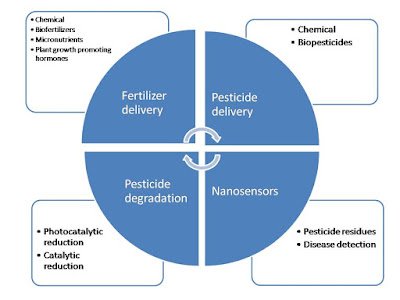
The use of nanomaterials for delivery of pesticides and fertilizers is explored to reduce the dosage and ensure controlled slow delivery but the risk assessment of the use of nanomaterials is still not defined. Toxicity of the ecosystem, potential residue carry-over in foodstuff and nanomaterials phytotoxicity are some of the major concern for application of nanomaterials in agriculture. The health concern of nanomaterials has been reviewed . There is need to evaluate the toxicokinetics and toxicodynamics of nanomaterials used in agricultural production. Nanomaterials owing to increased surface area might have toxic effects that are not apparent in the bulk materials especially in open agricultural ecosystem. The selection of nanomaterials for application in the field may be critical as materials which are non-toxic, biodegradable and biocompatible are desirable. Nanofabrication with hyper-accumulator plant or in combination with soil microorganism will provide the approach of “Designer plant” boosting up the nutrient uptake and phytomining efficiency.  This can be achieved in future by nano-biofarming or particle farming. This is one such field which yields nanoparticles for industrial use by growing plants in defined soil.

Smart precision farming will make use of computers, global satellite positioning system and remote sensing devices to measure highly localized environmental conditions enabling us to know whether crops are growing at maximum efficiency. Nanotechnology may be developed and deployed for real-time monitoring of the crop growth and field conditions including moisture level, soil fertility, temperature, crop nutrient status, insects, plant diseases, weeds. Networks of wireless nanosensors positioned across cultivated fields will provide essential data leading to best agronomic intelligence processes with the aim to minimize resource inputs and maximize output.

Humidity, light temperature, soil conditions, fertilization, insects, and plant diseases all affect the release of volatile organic compounds which could be detected by electronic nose. Electronic noses in agriculture will detect crop diseases, identify insect infestation, and monitor food quality. The electronic nose could also be used in food industry to assess the freshness spoilage of fruits and vegetables during the processing and packaging process. Smart dust technology will be used for monitoring various parameters such as temperature, humidity, insect and disease infestation in future. This is the future of agriculture, an army of nanosensors will be scattered like dust across the farms and fields, working like the eyes, ears and nosed of the farming world. These tiny wireless sensors are capable to communicate the information they sense. These will be programmed and designed to respond various parameters like variation in temperature, nutrients and humidity.


In summary, the development of nanomaterials with good dispersion and wettability, biodegradable in soil, and environment, less toxic and more photo-generative, with well understood toxicokinetics and toxicodynamics, smart and stable, and ease of fabrication and application in agriculture, would be ideal for their effective use in agricultural crop production.